Budapest HOHO Route Map Guide: Which Loop to Ride First
Decode Budapest hop-on hop-off route maps and choose the loop order that minimizes waiting and maximizes landmark time.
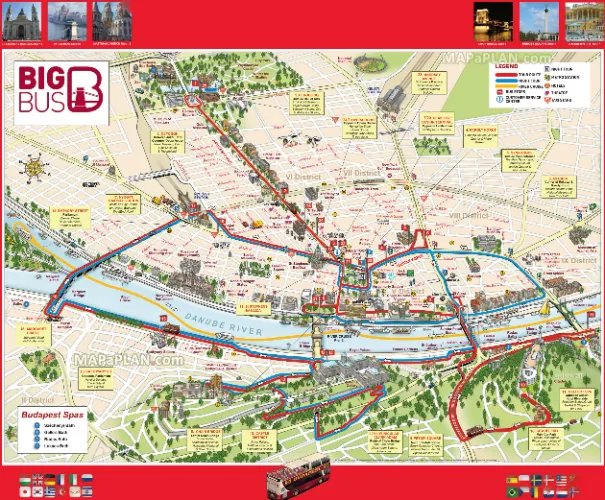
Maps look simple until city traffic and bridge bottlenecks join the story.
Read the route like a local
- Overlap zones: useful for fast transfers.
- Long arcs: best for rest periods.
- Bridge crossings: beautiful, but slower at peak times.
Practical decoding table
| Route behavior | What it means | What to do |
|---|---|---|
| Dense downtown stops | More landmarks per hour | Hop frequently |
| Long river segment | Fewer stops, better views | Stay seated |
| Shared central corridor | More vehicle frequency | Use for catch-up |
Timing heuristics
- Morning: choose broad overview loops.
- Midday: switch to dense central sections.
- Late afternoon: reserve scenic river-facing segments.
Quick formula
$$ \text{Best first route} = \frac{\text{landmark density} + \text{frequency}}{\text{expected congestion}} $$
The route map is not just geometry. It is choreography.
Reading flow instead of points
Experienced visitors think in sequences, not single stops. A smart sequence minimizes repeated bridge crossings, clusters indoor activities in hotter or wetter hours, and leaves panoramic stretches for calmer light. The beauty of Budapest is that each segment carries a different emotional tone, and route logic helps you place those tones intentionally.
Transfer rule
If you are unsure whether to hop off, stay on until the next overlap corridor. Optionality is a resource.
Route mastery is less about speed and more about reducing friction.
About the Author

Budapest Transit Insider
This guide was created to help visitors understand how Budapest hop-on hop-off tours actually work in practice—beyond marketing highlights—so you can choose smartly, travel comfortably, and enjoy the city with confidence.
Tags
Comments (0)
Loading comments...